 |
||||
 |
 |
 |
 |
 |
 |
 |
 |
 |
Knights of Ril
Writing Advice:
The World-Building of Crown Prince
In the most recent Outstanding Creator Awards, my book Crown Prince: Book One of New Blood won Best World-Building (among other awards, it did well, I’m very grateful). As a result, I’ve had some people asking me for tips about world-building. With that in mind, I decided to put together some of those thoughts all in one place.
I’ve heard people say that world-building is daunting (translation: intimidating). I’ve heard people say it’s too hard. I’ve even heard some say it’s the reason why they don’t write fantasy or why they write urban fantasy.
Personally, I love world-building. For me, it embodies everything that writing is about: creation. When world-building, the author literally gets to play god. What’s more fun than that?
So here are some broad strokes of how I went about building the world of Vaaldiss.
1) Map
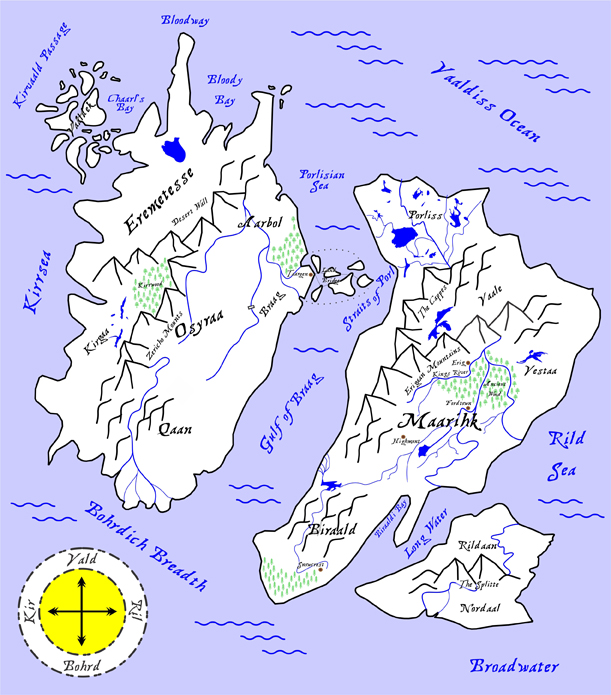
Where I usually start is with a map. I love maps. I have collected them since I was a kid. I sometimes get bored and draw them on my computer. So I literally have unused maps sitting around waiting for me to use them. For my New Blood Saga (for which Crown Prince is book one), I started with three things: a recurring dream I was having, a character I came up with while in college (who became Natharr), and a map. In this case, when I drew the map, I intentionally drew it so that the two main land masses looked like puzzle pieces that would fit together (just like Earth!). So what would cause the two land masses to exist? Two factions of gods having a war that they end up tearing the world in half, splitting it down the middle, taking control of their respective halves. So there are at least two different religions and at least two very distinct cultures.
2) Religions
Who lives in the lands on my map? There are two factions of gods. So one came first ... the Olde Gods. That makes the other gods the New Gods. Which set of gods do I like more as a person? Or is there one? In this case, I decided that I would model the Olde Gods along lines that I like. So the New Gods are the snotty upstarts. If that’s the case, then how do they still even exist? There are enough of them that they ... overpower the Olde Gods? No, too Greek. There are enough of them that they come to a stalemate. They split the world in half and ... they no longer physically walk on the world. They give up physical presence on the world. So it follows that the people worshipping these gods follow suit, right?
3) Populations
What race would the Olde Gods create? The world, nature, flora, fauna ... and the first people. What’s a cool name for that? The Olde Gods create the Firstborn. The other race is created by the New Gods (the snotty upstarts). What do you say to misbehaving children? “Ah-Ah, don’t touch that!” I thought, “Why not?” So the new race created by the New Gods are called the Aa. The Olde Gods created the animals ... why? I decided at some point that there are only four Olde Gods (four gods, four compass points: Vald, Bohrd, Kir, and Ril), so they created them to be their army against some evil force. So they’re not just “animals.” That doesn’t sound like an army. They need a cooler name ... like Great Beasts. And what are the Firstborn? The last of the Great Beasts ever created. They are bigger than the Aa. They live longer. They don’t reproduce as much. They are broader in the shoulders and narrower in the hips (like comic-book superheroes). They can also see into the future ... sometimes ... and not all of them. Has to be limited or the Aa wouldn’t have stood a chance. The Aa reproduce like rabbits. They overcome the Firstborn with mass numbers. They can’t even perceive of the mysteries of creation because it’s all about the here and now ... they lack imagination. After they win the war, they force the surviving Firstborn into a corner of the world, one island, very small compared to the rest of the world. They then change the names of things, inserting double Aa into most of the names. But the Aa and the Firstborn can interbreed ... and they do ... and Firstborn culture seeps into Aa culture ... at least on that half of the world. And what’s that great evil the Olde Gods have to fight? Not other gods ... that’s already being done ... Demons. Yeah ... Demons of Chaos.
4) Cultures
There are different nations on these two lands. What kinds of cultures do I want? In the lands surrounding Maarihk (where the Firstborn were created), I want it to be more European-ish, maybe with some Celtic flair, because the ancient wood is so central to creation of the Firstborn and all the Great Beasts. A little bit of ancient Greece for flavor would be OK, particularly with the Great Beasts. There is an area pretty much cut off by mountains ... mountain savages? That could be interesting ....
What about the other land mass (on the left)? On the map, the biggest piece of it is flat ... savannahs? So maybe they’re nomadic? What nomadic cultures do I like? I’ve studied Native American culture since elementary school. That’s a no-brainer. But I don’t want to just make them an Indian tribe. What other nomadic culture could be mixed in to make it original? The nomadic culture is powerful ... so the Mongols? Yeah ... that would be cool. I always wanted to learn more about the Mongols, so this is my chance!
Then there is the country between the nomadic countries and the other land ... it’s a blend of cultures (the two worlds).
Clearly, a lot more went into it than this. But this is literally how it went (in broad strokes). I took things I had in hand and played with them, spinning them into things that I thought would be fun to research, enjoyable to read, and made sense with the map and with the history that was inspired by its imagery. When these things were in place, I started writing Crown Prince.

Writing Advice: Writing a Story
Writing Advice: ChoosingYour Narrative: Character-Driven or Plot-Driven
Writing Advice: Stuff People Usually Get Wrong
Writing Advice: Your Story Is Your Starship; Conflict Is Your Fuel
Writing Advice: What is the Best Advice You Could Give an Aspiring Author?
Writing Advice: Irony: It's Not Just Heavy Metal
Writing Advice: Writer Burnout Arises from Misapplied Focus
Writing Advice: Why We Fall in Love With Characters
Writing Advice: Two Successful Authors, Four Questions
Writing Advice: I Have a Great Idea, How Do I Start Writing?
Author Interview: Nicolas Lemieux
Author Interview: Clay Vermulm
Author Interview: Jasveer Singh Dangi
Author Interview: Rune S. Nielsen